A crew you can watch work.
Five specialist subagents for Pi, and a status line that shows what each one is doing right now, what it has spent, and how full your context is.
pi install npm:pi-subagents && pi install npm:pi-nd-crew
Rendered by the extension's own drawing code. Type orchestrate in a prompt, or run /ship <task>.
Five strengths, each with a guardrail
The personas use words neurodivergent people use about themselves: hyperfocus, monotropism, body doubling, spoons. Each persona works the way its strength works. Its tools and limits cover the matching weak spot.
pattern Analyser, autistic systemizing
Reads the request literally and works bottom-up. Returns every relevant file, symbol and call site with file:line, plus any inconsistencies it noticed.
Read-only, three-minute limit, 300 words.
mapper Thinker, dyslexic big picture
Sees how the parts connect and turns pattern's evidence into a numbered plan: goal, steps, risks and the exact commands that prove it worked.
Read-only, and it starts from pattern's evidence instead of rescanning the repo.
hyperfocus Implementer, ADHD sprints
Momentum on one step at a time. Ideas outside the step go to a parking lot instead of the diff.
Saves the plan to a file and re-reads it before each step. Thirty-minute timebox. The footer's flame shows drift.
literal Reviewer, rule-keeping and fairness
Checks the diff against the plan and your exact words. Flags anything done that you did not ask for, and anything skipped without telling you.
Read-only, ten findings at most, an explicit approve or request-changes verdict.
bodydouble Advisor, ADHD body doubling
Sits with the main agent after an edit-heavy prompt and reads the changes. Speaks only when work drifts from what you asked.
One line. Silent when everything is on track.
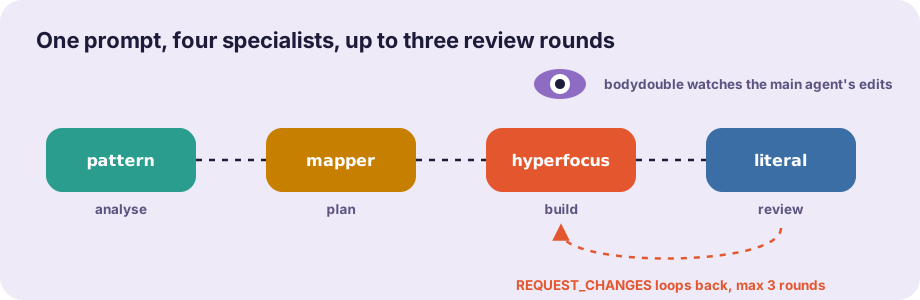
From prompt to approved diff
Requested changes go back to hyperfocus, up to three rounds. You approve the plan before any code changes, unless you have already said to proceed.
Everything in three lines
The footer never grows past three lines. Live workers always say what they are doing. Finished ones shrink to small chips on narrow terminals.
- Phase strip
- Analyse, plan, build, review, the review round, and elapsed time.
- Main line
- Model and thinking level, context fill with exact tokens, session cost to four decimals, what the workers have spent, cache hit rate.
- Sprite faces
- Reading, editing, running, thinking, waiting for an answer, done, failed or stopped, next to the tool and file it is using.
- The flame
- Hyperfocus's drift meter. It heats up to amber, then red, as edits pile up without a plan re-read.
- Spoons
- Your session budget. When it runs out, new subagents are blocked until you raise it with
/nd spoons. - ≈$
- A live estimate that turns exact when the run reports final usage.
- alt+a
- The fleet view: every worker's model, tokens, cache, cost and last output, with steer and stop.
Measured on its own repository
No benchmarks we cannot show you. These come from running nd-crew while building nd-crew.
| +0% CPU | Idle CPU with and without nd-crew over a fifteen-second sample. Animation timers only run while a worker is live. |
| 3 lines | The most the footer ever takes, at any width from sixty columns up. |
| 0 deps | No runtime dependencies. About 80 kB of TypeScript that Pi loads as source. |
| 34 tests | Including a replay of a real /ship run's event stream. |
| ~2 min | The crew implemented one of its own features through orchestrate: refactor plus tests, approved by literal in the first round. |
What it adds to pi-subagents
nd-crew runs on top of pi-subagents and uses the same engine. oh-my-pi builds roles, an advisor and an agent hub into a fork of Pi. nd-crew brings that way of working to stock Pi as one package.
| pi-subagents alone | with nd-crew | |
|---|---|---|
| Specialist agents | General builtins: scout, worker, reviewer, oracle | Five personas with matched guardrails and fixed handoffs |
| Start a crew run | Prompt templates such as /review-loop | Say orchestrate, or run /ship |
| Watching workers | Its own widget and FleetView | One footer for the main session and every worker |
| Drift meter, phase strip, timebox | Yes | |
| Advisor after edits | Ask the oracle | Automatic, one line, silent when on track |
| Session-wide spend cap | Spoons budget blocks new subagents | |
| Low-sensory mode | /nd calm, NO_COLOR, PI_REDUCED_MOTION=1 |
Start in a minute
- Install the engine:
pi install npm:pi-subagents - Install the crew:
pi install npm:pi-nd-crew - Remove any other footer package. Pi shows one footer.
- In Pi, type
orchestratefollowed by your task, or run/ship <task>. Pressalt+ato see every worker.